B2B Email Marketing Strategy 2026: How to Build Campaigns That Convert
- Growth Tactics, Marketing, Trending

Team Zintlr
Share This Post
Introduction: Why Your B2B Email Strategy Needs a Data Overhaul
Low open rates. Stagnant pipeline. Email campaigns that don’t convert into opportunities. If this sounds familiar, your B2B email marketing strategy is likely built on assumptions, not data.
Here’s the reality: Business decision-makers receive 121 emails per day on average (Statista, 2025). Yet despite inbox saturation, email remains the highest-ROI B2B marketing channel, delivering 4,200% return for every dollar spent according to the Direct Marketing Association.
The difference between winning and struggling teams? Data-driven segmentation and strategic positioning. Companies using segmented B2B email marketing campaigns see 14.31% higher open rates and 100% higher click-through rates compared to generic broadcasts (HubSpot, 2024).
In 2026, inboxes are crowded, buyers are distracted, and algorithms are stricter. Yet email is still the most effective B2B marketing channel for generating qualified pipeline—when it is data-driven and strategically targeted.
This complete guide teaches you how to build a high-performance B2B email marketing strategy that reaches the right accounts, improves reply rates, and creates measurable revenue impact for your sales and marketing teams.
What Is B2B Email Marketing? Definition & Key Differences From B2C
B2B email marketing is the strategic use of email to reach business decision-makers, educate them about solutions, build trust over time, and ultimately influence complex buying decisions across multiple stakeholders and longer sales cycles.
Unlike B2C email marketing—which focuses on quick conversions, discounts, and immediate transactions—B2B email marketing prioritizes:
- Complex multi-stage buying journeys spanning weeks or months
- Multiple decision-makers (CFOs, CMOs, CTOs, Operations leaders)
- Educational content that builds credibility and thought leadership
- Trust-based relationship building over time, not immediate sales
- Revenue alignment directly supporting pipeline and qualified meetings
Key Insight: B2B email marketing is NOT about sending more emails. It’s about sending the RIGHT emails to the RIGHT people at the RIGHT time in their buying journey. This strategic approach is why data-driven segmentation and email deliverability matter so much.
Why B2B Email Marketing Remains Critical in 2026
With AI automation, social media advertising, and community platforms expanding rapidly, many teams question whether email still matters. The data tells a completely different story.
Email Remains Essential Because:
1. Email Is Owned Media (You Control Distribution)
Unlike LinkedIn, Facebook, or Google Ads—where algorithm changes can eliminate your reach overnight—email lives in your CRM. No algorithm middleman. No dependency on platform updates. Direct access to your audience, always. This is why building an owned channel through email marketing remains critical for sustainable B2B marketing.
2. Email Drives Higher ROI Than Most Channels
Proof Point: Forrester Research (2024) found that email generates $42 in revenue for every $1 spent—higher than paid search ($17), social media advertising ($11), or display ads ($9). For B2B companies specifically, email marketing ROI typically exceeds 300%.
3. Email Powers the Entire Customer Lifecycle
- New Business: Cold outreach, prospecting, and lead generation
- Lead Nurture: Education, relationship building, and trust establishment
- Sales Enablement: Case studies, battle cards, product information, competitive positioning
- Customer Success: Onboarding, feature adoption, expansion campaigns, upsells
- Retention: Win-back campaigns, renewal reminders, loyalty programs, customer advocacy
4. Email Integrates Seamlessly With CRM & Sales Tools
Your marketing automation platform connects email performance directly to pipeline data. You can track which campaigns influence deals from first touch to close—something paid channels cannot guarantee. This attribution capability makes email marketing essential for demonstrating marketing ROI.
Bottom Line: A data-driven B2B email marketing strategy is one of the most reliable ways to support pipeline growth, deepen customer relationships, drive predictable revenue, and maintain direct communication control with your audience.
The 3 Core Pillars of High-Performing B2B Email Campaigns
Pillar #1: Data Quality & Targeting Accuracy
Garbage data equals garbage results. If your contact information is outdated, incomplete, or inaccurate, your campaigns will fail regardless of subject line optimization or email deliverability setup.What “quality data” means for B2B email marketing:- ✓ Valid, verified work email addresses (not personal Gmail or Yahoo)
- ✓ Accurate company information (industry, company size, revenue range)
- ✓ Current job titles and decision-maker roles
- ✓ Regular list maintenance (bounce rates under 2%)
- ✓ Compliance with GDPR, CAN-SPAM, CASL, and local regulations
- ✓ Updated engagement history and behavioral data
Pillar #2: Strategic Segmentation & Message Relevance
Segmentation transforms a generic list into micro-targeted audiences. Instead of sending the same “company newsletter” to everyone, you send contextual messages to specific groups based on their needs, behavior, and position in the buying journey.Top Segmentation Variables for B2B Email Marketing:- Firmographics – Industry, company size, revenue, location, growth stage
- Role & Persona – CMO vs. CTO vs. CFO vs. Operations leader
- Engagement Level – Open/click history, webinar attendance, content downloads
- Lifecycle Stage – Early awareness, consideration, decision, customer, renewal
- Product Usage – Active users, inactive users, power users, at-risk users
- Deal Stage – Marketing qualified lead, sales qualified lead, in-negotiation, closed-won
Pillar #3: Email Deliverability & Inbox Placement Strategy
Email deliverability is the percentage of emails that land in the inbox (not spam, promotions folder, or bounced). It’s often the silent reason why “good campaigns” underperform dramatically.If your deliverability is 85%, you’re losing 15% of potential conversations before recipients even see your message. If it’s 70%, you’re losing a third of your audience to spam filters.How to Protect & Improve Email Deliverability:- ✓ Authenticate your domain: Set up SPF, DKIM, and DMARC records
- ✓ Warm up new sending domains gradually: Start with 50-100 emails day 1, increase by 20-30% daily
- ✓ Maintain sender reputation: Keep bounce rates below 2%, complaint rates below 0.1%
- ✓ Avoid spam triggers: Limit ALL CAPS, excessive punctuation, spammy keywords, too many links
- ✓ Use reputable ESPs: SendGrid, Klaviyo, HubSpot, Marketo, ActiveCampaign
- ✓ Monitor sender score: Check 250ok.com or Return Path regularly
- ✓ Practice list hygiene: Remove bounced and unengaged contacts monthly
Share This Post
How to Build Your B2B Email Marketing Strategy: Step-by-Step
Step 1: Define Clear Revenue Goals & Success Metrics
Start with outcomes, not activities. Ask yourself these critical questions:
- What percentage of our pipeline should email influence?
- Are we focused on new business, customer expansion, or retention?
- How many qualified meetings do we need from email campaigns monthly?
- What’s our target cost per acquisition (CAC) via email?
- Which email campaigns drive the most pipeline influence?
Example Goal: “Email will influence 30% of our new business pipeline and generate 50 qualified meetings per month, with a customer acquisition cost of $800 or less.”
When email is tied to specific pipeline stages and revenue targets, campaigns become easier to measure, justify, and optimize.
Step 2: Map Email Campaigns to the Buyer Journey
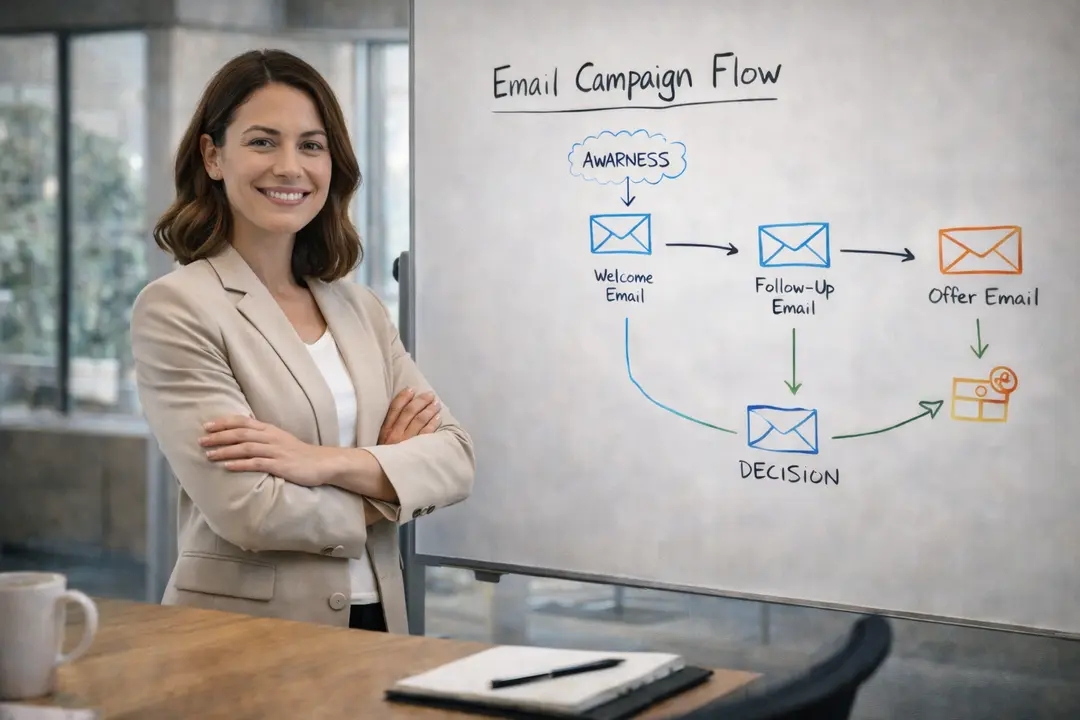
B2B buyers rarely convert from a single touch. Instead, they move gradually through three main phases. Each requires different email content, messaging, and objectives.
The Three B2B Buying Stages:
- Awareness Stage: Buyer recognizes they have a problem. Email focus: Educational content, problem frameworks, industry insights, thought leadership
- Consideration Stage: Buyer explores potential solutions and options. Email focus: Case studies, competitive comparisons, product demos, ROI calculators, webinars
- Decision Stage: Buyer chooses a vendor and justifies ROI. Email focus: Social proof, customer testimonials, pricing guides, free trial offers, final objection handling
Design specific email campaigns that support each stage of the buyer journey. This alignment dramatically improves conversion rates and prevents prospects from falling through the cracks.
Step 3: Create Repeatable Email Flows (Not One-Off Blasts)
The difference between winning teams and struggling teams: winners build automated email flows (multi-email sequences), while struggling teams send random blasts.
Essential Email Flows Every B2B Company Needs:
- Cold Outreach Flow: 5-7 emails over 2-3 weeks for completely unengaged prospects
- Welcome/Onboarding Flow: 3-4 emails for new leads or free trial signups
- Lead Nurture Flow: 6-8 emails for early-stage prospects showing interest
- Re-engagement Flow: 3-4 emails to bring inactive/cold contacts back to life
- Customer Expansion Flow: 4-5 emails to existing customers about upsells and add-ons
- Webinar Follow-up Flow: 3-4 emails for attendees and no-shows
- Event Follow-up Flow: 3-5 emails for conference attendees and trade show leads
Why Flows Win: Flows are measurable, testable, and reusable across campaigns. They automate touchpoints, improve consistency, and free your team to focus on strategy instead of manual sends.
Advanced Email Segmentation Strategies for B2B SaaS Marketing
For B2B SaaS companies, basic segmentation isn’t enough. You have rich product usage data—use it strategically.
Segment by Product Behavior & Usage Patterns
- Power Users: Logging in 3+ times weekly, using advanced features, high feature adoption → Upsell campaigns, feature education, advocacy programs
- Active Users: Using product 1-2 times weekly, completing core workflows → Engagement campaigns, best-practice tips, feature highlights
- At-Risk Users: Declining usage over 3 weeks, missing key activities → Re-engagement campaigns, check-ins, value reminders
- Inactive Users: No logins in 30+ days, no activity for 60+ days → Cancellation prevention, win-back campaigns, satisfaction surveys
Segment by Customer Persona & Decision-Making Role
Different roles care about completely different things. Tailor your messaging by persona:
- CFOs/Finance Buyers: Focus on ROI, cost savings, compliance, total cost of ownership
- CMOs/Marketing Buyers: Focus on lead generation, attribution, campaign performance, analytics
- CTOs/Technical Buyers: Focus on integration, security, scalability, API documentation, performance
- Operations Leaders: Focus on workflow efficiency, automation, team training, process improvement
- HR/People Leaders: Focus on adoption, training, change management, team productivity
Real-World Example: A MarTech platform sends completely different emails to different buyers at the same company:
- To the CMO: “How to 3x your lead generation with automated nurturing campaigns”
- To the CTO: “Enterprise-grade security features and API documentation”
- To the CFO: “Reduce marketing tech stack costs by 40% with consolidation”
Same product. Three different pitches. Three times the relevance. Three times the engagement.
Real B2B Email Examples That Actually Convert
Example 1: High-Converting Cold Email Template
Subject Line: Quick thought on {{CompanyName}}’s {{RecentMetric}}
Email Body:
Hi {{FirstName}},
I was looking at {{CompanyName}}’s recent {{Achievement}} and thought of you.
Most {{RoleTitle}} in {{Industry}} are trying to {{Challenge}} without adding headcount. Are you dealing with this too, or is something else higher priority right now?
If it’s relevant, I’ve seen {{CompanyType}} teams reduce {{Metric}} by {{Result}}.
Worth a quick conversation?
Best,
{{YourName}}
- ✓ Personalized opening shows research effort
- ✓ Problem-focused (not product-focused)
- ✓ Includes social proof element (specific results from similar companies)
- ✓ Simple yes/no CTA (reduces decision friction)
- ✓ Short and scannable
- ✓ Professional but conversational tone
Result: When one B2B SaaS company used this template, cold email reply rate jumped from 3.2% to 7.8% on outreach campaigns.
Example 2: High-Value Nurture Email for Decision-Makers
Subject Line: 3 things we learned from {{CompanyName}}’s recent {{NewsItem}}
Email Body:
Hi {{FirstName}},
Saw your company’s announcement about {{SpecificEvent}}. Congrats!
It reminded me of a framework we use with similar teams:
The Three Phases of {{ProcessName}}:
Phase 1: {{Explanation}} – {{Specific Benefit}}
Phase 2: {{Explanation}} – {{Specific Benefit}}
Phase 3: {{Explanation}} – {{Specific Benefit}}
We put together a one-page breakdown that might be useful for your {{Department}} team. Would that be helpful?
Best,
{{YourName}}
- ✓ References something specific about their company (shows research)
- ✓ Provides actual value (framework, not just a pitch)
- ✓ Single clear CTA (not multiple competing asks)
- ✓ Positions you as a helpful resource, not a pushy salesperson
- ✓ Low-commitment ask (simple “yes, send it” response)
Example 3: Customer Expansion Email (Upsell Campaign)
Subject Line: {{CompanyName}} could save {{TimeSaved}} hours/month with {{NewFeature}}
Email Body:
Hi {{FirstName}},
Your team has been doing great with {{CurrentFeature}} over the last {{TimeFrame}}.
A lot of teams like yours are now using {{NewFeature}} to {{Outcome}}. It typically takes about {{ImplementationTime}} to set up.
Would it make sense to hop on a 20-minute call so I can show you what it looks like?
Best,
{{YourName}}
- ✓ References their actual usage (shows you pay attention)
- ✓ Frames benefit in tangible terms (time saved, clear outcome)
- ✓ Clear, low-commitment ask (short call, not a big demo)
- ✓ Leverages existing relationship and trust instead of feeling cold
Share This Post
Essential Metrics: How to Measure B2B Email Performance
B2B Email Marketing Metrics That Actually Matter
Vanity metrics like “opens” can be misleading. These are the email performance metrics that tie directly to revenue.
- Deliverability Rate: % of emails reaching inbox. Target: 95%+
- Open Rate: % of recipients opening the email. B2B Avg: 21% — Target: 20–35%
- Click-Through Rate (CTR): % who clicked a link. B2B Avg: 2.5% — Target: 2–5%
- Reply Rate: % who replied. Target: 2–8% (indicates real intent)
- Conversion Rate: % taking desired action. Target: 1–3%
- Meeting Booked Rate: % of replies turning into meetings. Target: 30–50%
- Pipeline Influenced: % of revenue influenced by email campaigns. Target: 15–30%
- CAC (Customer Acquisition Cost): Cost to acquire a customer via email. Target: Under $1,000
Track pipeline influenced above all else — this is the number your CFO and CEO truly care about.
Common B2B Email Mistakes (And How to Fix Them)
Mistake #1: Sending the Same Email to Everyone
The Problem: Generic emails get generic results. Mass blasts to unsegmented lists feel impersonal and get ignored or marked as spam.
The Fix: Segment first. Send to smaller groups with personalized, relevant messages. Quality over quantity always wins in B2B email marketing.
Mistake #2: Too Many CTAs in One Email
The Problem: “Learn more / Download guide / Watch video / Book a demo / Follow us on LinkedIn” creates decision paralysis. Recipients take no action.
The Fix: One email equals one goal equals one primary CTA. Everything else distracts from your main objective.
Mistake #3: Ignoring Email Deliverability Until Too Late
The Problem: Poor sender reputation, low authentication, bounced addresses send emails to spam. Wasted campaigns, no visibility.
The Fix: Monitor deliverability metrics weekly. Fix sender reputation issues immediately. Use tools like 250ok or Return Path.
Mistake #4: Measuring Success by Opens, Not Revenue
The Problem: A 25% open rate is meaningless if it drives zero pipeline or no qualified meetings.
The Fix: Connect email performance to CRM data. Track which campaigns influence opportunities, deals, and revenue.
Mistake #5: No Clear Sales-Marketing Handoff Process
The Problem: Marketing nurtures leads, but sales doesn’t know when/how to take over. Leads go cold and opportunities are lost.
The Fix: Define clear handoff criteria. When a lead hits a score threshold or engagement level, marketing passes to sales immediately with context.
FAQs: B2B Email Marketing Strategy
How often should I send B2B emails to avoid unsubscribes?
Cold outreach: 1 email per week in a sequence. Nurture campaigns: 1–2 emails per week. B2B newsletters: 2 emails per month. If unsubscribe rates exceed 0.5%, reduce volume.
What is a good open rate for B2B email campaigns?
Industry benchmark is 18–25%. Cold outreach: 15–20%. Highly segmented campaigns can exceed 30–40%. Focus more on reply rate (2–8%) than open rate.
Should I use personalization tokens or dynamic content?
Yes. Personalization tokens (name, company, industry) increase opens by 20–30%. Dynamic content based on behavior significantly improves engagement and conversions.
What is the ideal length for B2B marketing emails?
Cold emails perform best when 50–125 words. Nurture emails: 100–200 words. Keep messaging concise and CTA clear.
When is the best time to send B2B emails?
Typically Tuesday–Thursday between 8–11 AM or 2–4 PM in the recipient’s timezone. However, A/B testing your own list always gives better results.
How can I improve B2B email deliverability?
Authenticate domains with SPF, DKIM, and DMARC. Keep bounce rate under 2%. Clean lists regularly. Use reputable ESPs and avoid spammy words in subject lines.
How long should a B2B nurture sequence run?
Most nurture sequences run 4–8 weeks with emails spaced 3–5 days apart. Cold outreach sequences run 2–3 weeks.
Conclusion: B2B Email Marketing as Your Revenue Engine
In 2026, B2B email marketing isn’t about volume—it’s about precision, strategy, and data-driven execution.
When your B2B email marketing strategy is built on clean data, smart segmentation, strong deliverability, and continuous testing and optimization, email becomes one of your most reliable revenue channels.
Your immediate action steps:
- Audit your current email list quality and deliverability this week
- Segment your audience into at least 3-5 micro-groups based on behavior or role
- Create one new email flow (welcome, cold outreach, nurture, or re-engagement)
- Connect your email performance to pipeline data in your CRM
- Test one change per week and measure results systematically
Email isn’t dead. It’s just waiting for you to use it smarter. A data-driven B2B email marketing strategy is one of the most reliable ways to support pipeline growth, deepen customer relationships, and drive long-term revenue.
Start today. Test small. Scale what works. Measure everything. That’s how top-performing B2B teams use email marketing as a revenue engine.