Choosing between PLG and SLG isn’t about philosophy, it’s about analyzing specific signals in your business. Here’s the framework Zintlr’s highest-growth customers use to make this decision.
For additional strategic frameworks to guide your GTM approach, explore our 10 Proven Go-To-Market Frameworks for B2B SaaS.
Factor 1: Product Complexity & Time-to-Value
Can a new user achieve meaningful value in under 15 minutes without human help?
 PLG Signal
Your product is intuitive enough for users to onboard themselves. Setup takes minutes, not hours. Users reach their “aha moment” quickly and independently.
Example: Notion users can create their first workspace in under two minutes. Canva users design their first graphic within five minutes.
SLG Signal
Your product requires significant configuration, data migration, or integration work. Users need training to understand core workflows. Value isn’t immediately obvious without guidance.
Example: Workday implementations take 4-9 months with dedicated consultants. Salesforce requires custom object modeling, workflow automation setup, and user training.
Factor 2: Average Contract Value (ACV)
What’s your target annual contract value per customer?
PLG Signal
ACVs under $15K make it economically challenging to support expensive sales teams. Self-service conversion with low-touch sales assistance is more profitable.
2025 Data Point: PLG companies with ACVs between $3K-$12K achieved 47% gross margins through self-service efficiency. Adding sales teams to these deals reduced margins to 32% without improving conversion.
SLG Signal
ACVs above $50K justify dedicated sales resources. Complex deals with multiple stakeholders require human orchestration.
2025 Benchmark: Companies with $100K+ ACVs that tried PLG-only approaches saw 68% lower close rates compared to peers with dedicated account executives.
The Gray Area ($15K-$50K)
This is where hybrid models shine. Start with PLG to reduce friction, then layer in sales for expansion and enterprise deals.
Factor 3: Sales Cycle Length
How long does it take from first contact to closed deal?
PLG Signal
Purchase decisions happen quickly—within days or weeks. Buyers are individual contributors or small team leads who can swipe a credit card without procurement approval.
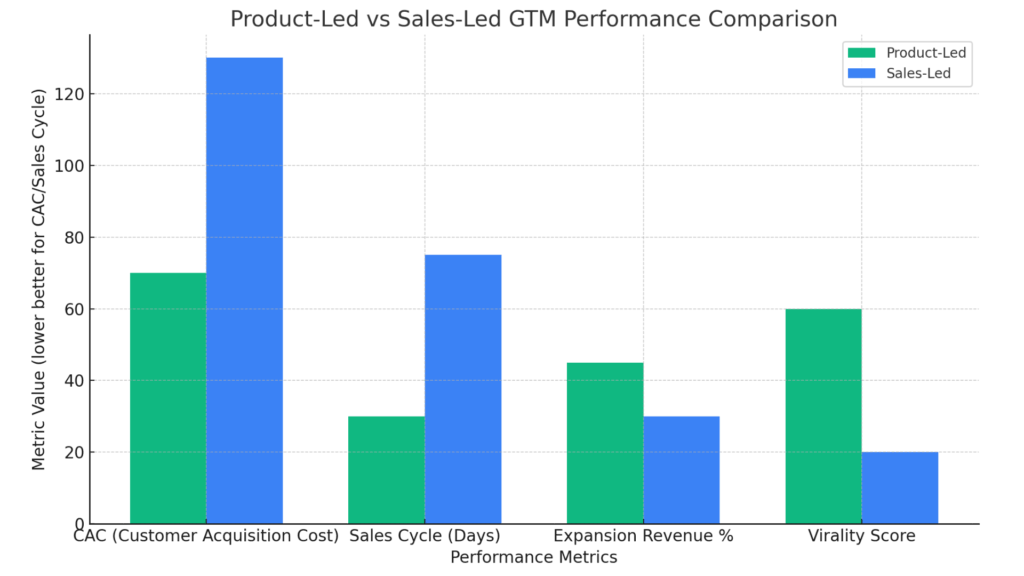
Metric: High-performing PLG companies convert free users to paid within 7-21 days on average.
SLG Signal
Deals involve 3-12 month evaluation cycles with multiple stakeholders, security reviews, procurement negotiations, and legal contracts.
Reality Check: McKinsey’s 2025 enterprise software research found the average B2B SaaS deal over $100K now takes 5.3 months—up from 4.1 months in 2022.
Factor 4: Target Buyer Persona
Who is your ideal customer, and how do they prefer to buy?
PLG Signal
Your buyers are individual contributors, small business owners, or startup teams. They’re tech-savvy, prefer self-service, and actively avoid sales calls.
Buyer Behavior: Developers, designers, marketers, and product managers overwhelmingly prefer PLG buying experiences.
SLG Signal
Your buyers are C-suite executives, VPs, or enterprise procurement teams. They expect white-glove service, personalized demos, custom proposals, and strategic consultation.
Buying Committee Dynamics: Enterprise deals typically involve 6-10 decision makers across finance, IT, legal, operations, and business units.
Factor 5: Customization Requirements
Does your product work out-of-the-box, or does it require configuration?
PLG Signal
Your product delivers value with zero customization. Users can start immediately with sensible defaults.
Example: Grammarly works perfectly without any setup. Calendly functions immediately with default availability settings.
SLG Signal
Your product must be tailored to customer workflows, integrated with existing systems, or configured for specific use cases.
Example: Coupa (spend management) requires custom approval workflows, integrations with ERP systems, and category-specific configurations.

_zk_6fWQRo.png?updatedAt=1763969043710)


 Products with immediate, obvious value (users can “get it” in under 10 minutes)
 PLG Signal
 SLG Signal